
Lesser Florican, Great Indian Bustard & Forest Owlet (Kashmir to Grasslands) 21 Days
The India’s Monsoon Specialities Birding Tour is an extensive 21-day expedition designed for serious birders seeking India’s most elusive and season-dependent species. Timed perfectly with the monsoon, this tour targets a remarkable range of rare, endemic, and highly localized birds that are either extremely difficult—or nearly impossible—to observe outside this season.
From the lush Himalayan valleys of Kashmir to the monsoon grasslands of Rajasthan, the Thar Desert, and the biodiverse Western Ghats, this journey covers an extraordinary variety of habitats. Key highlights include the aerial displays of the Lesser Florican, the critically endangered Great Indian Bustard, the rediscovered Forest Owlet, and a wide range of monsoon specialists such as Bristled Grassbird and Broad-tailed Grassbird.
With expert guidance, carefully selected birding sites, and strategic timing, this tour offers exceptional opportunities to observe India’s rarest birdlife while experiencing dramatic seasonal landscapes at their most vibrant.
Detailed Itinerary
Day 1 – Arrival in Delhi
Arrive at Delhi International Airport, where our representative will meet you and assist with transfer to your hotel. Delhi is often the first introduction to India’s diversity, and depending on arrival time, you may see common urban birds around the hotel gardens. The rest of the day is kept free for rest and recovery after international travel. Overnight in Delhi.
Days 2–3 – Delhi to Srinagar (Gateway to the Himalayas)
We begin early with birding in wet grassland and marshy habitats around Delhi. During the monsoon, these areas become active with breeding birds, and we focus on the highly localized Bristled Grassbird, which performs striking display flights above tall grasses during early morning hours.
After birding, we transfer to the airport for a scenic flight to Srinagar. As we approach Kashmir, the landscape shifts dramatically from plains to forested Himalayan valleys. Arrival is followed by transfer to hotel and relaxation. Overnight in Srinagar.
Days 4–7 – Kashmir Valley Birding (Himalayan Forests & Valleys)
These four days are dedicated to exploring the pristine Himalayan ecosystem around Srinagar, covering multiple elevations and habitat types including conifer forests, mixed woodland, river valleys, and forest edges.
Early mornings are spent in active birding sessions when bird activity is highest. Target species include Kashmir Nuthatch, White-cheeked Nuthatch, Kashmir Nutcracker, Rufous-naped Tit, and Tytler’s Leaf Warbler—all key Himalayan specialties.
Mid-elevation forests may produce mixed flocks containing woodpeckers, minivets, tits, and warblers. We also search carefully for laughingthrushes, rosefinches, grosbeaks, and flycatchers moving through forest edges.
If conditions are favorable, we may encounter the elusive Orange Bullfinch, a highly sought-after species restricted to higher elevation Himalayan forests. Each day involves slow-paced, careful birding with frequent stops for scanning mixed flocks. Overnight in Srinagar.
Day 8 – Srinagar to Jaipur (Transition from Himalayas to Plains)
A final early morning session in Kashmir before flying via Delhi to Jaipur. This day marks a dramatic ecological transition—from cool Himalayan forests to the dry, warm landscapes of Rajasthan. Arrival in Jaipur is followed by hotel transfer and rest. Overnight in Jaipur.
Days 9–10 – Ajmer Grasslands (Lesser Florican Breeding Grounds)
We drive to Ajmer, entering semi-arid grassland and scrub habitats that come alive during the monsoon season. Early mornings are crucial, as this is when birds are most active.
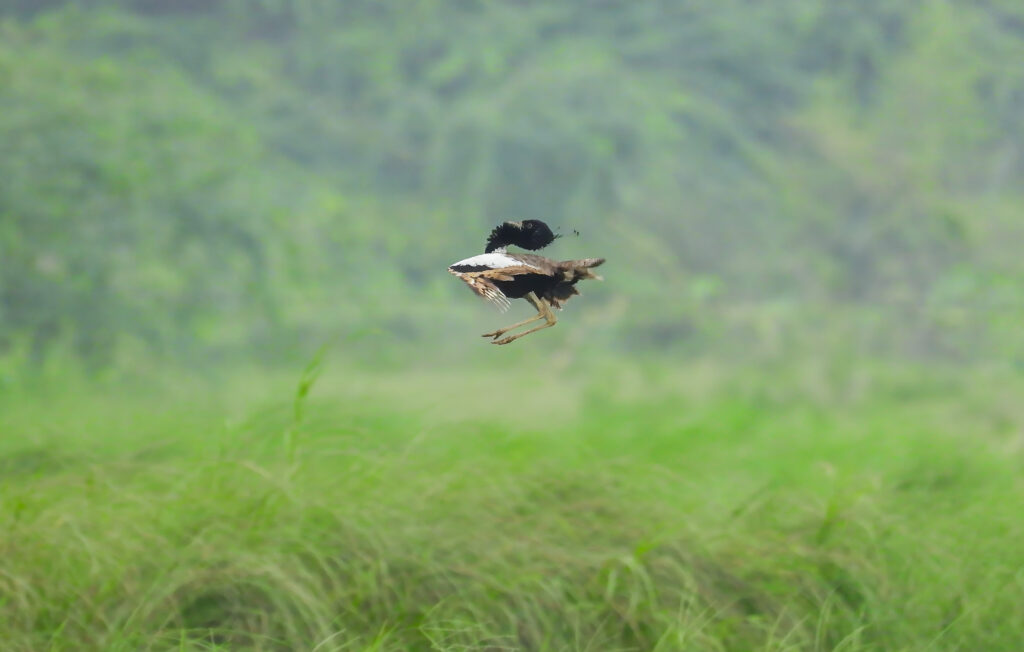
The highlight is the spectacular Lesser Florican, whose males perform vertical jumping display flights in open grasslands during breeding season. Observing this behavior is one of India’s most unique birding experiences.
We also explore surrounding habitats for Rock Bush Quail, Rain Quail, Indian Pitta, Black-breasted Weaver, Singing Bushlark, and Red-necked Falcon. Careful scanning of scrub edges may also reveal the elusive Painted Francolin. Evenings are often spent reviewing sightings and planning early starts for the next day. Overnight in Ajmer.
Day 11 – Ajmer to Tal Chhapar (Grassland Transition Zone)
After morning travel, we reach Tal Chhapar, a unique protected grassland surrounded by thorn scrub forest. This ecosystem represents one of the best remaining examples of natural dry grassland in India. Afternoon birding focuses on open plains and woodland edges. Overnight in Tal Chhapar.
Day 12 – Tal Chhapar Grassland Exploration
A full day dedicated to systematic exploration of grassland and scrub habitats. Early morning and late afternoon are most productive.
Our main target is the highly localized Indian Spotted Creeper, often found foraging on tree trunks in open woodland patches. We also search for Black Francolin, Rock Bush Quail, and a range of raptors patrolling the open skies.
Large herds of Blackbuck are commonly seen grazing in open grasslands, adding a strong wildlife component beyond birding. The area is quiet, open, and excellent for long observation sessions. Overnight in Tal Chhapar.
Day 13 – Tal Chhapar to Jaisalmer (Entering the Thar Desert)
We depart early toward Bikaner, stopping at a vulture feeding station where multiple scavenger species may be observed depending on availability. Later we continue into the Thar Desert landscape toward Jaisalmer.
In the evening, we visit the Wood Fossil Park, where rocky desert terrain provides habitat for Indian Eagle Owl, Desert Lark, and other arid-zone specialists. The atmosphere changes dramatically as we enter true desert ecosystems. Overnight in Jaisalmer.
Days 14–15 – Desert National Park (Great Indian Bustard Habitat)
These two days are fully dedicated to exploring the vast dunes, grasslands, and scrub desert of Desert National Park—one of India’s most important and fragile ecosystems.
We conduct early morning and late afternoon surveys for the Critically Endangered Great Indian Bustard, scanning vast open plains carefully for this extremely rare species. Encounters are always special and unpredictable.
Other species include Stoliczka’s Bushchat, Cream-coloured Courser, Chestnut-bellied Sandgrouse, Desert Lark, and multiple vulture species, including critically endangered populations.
The desert environment is harsh but visually stunning, with vast horizons and minimal human disturbance. Overnight in Jaisalmer.
Day 16 – Jaisalmer to Pune (Desert to Western Ghats Transition)
After morning travel, we fly from Jaisalmer to Mumbai and continue by road to Pune. The scenery shifts dramatically from arid desert to green hills and monsoon vegetation as we approach the Western Ghats foothills. Overnight in Pune.
Day 17 – Pune Grasslands (Monsoon Explosion of Life)
We explore grasslands and scrub habitats around Pune, which become highly productive during the monsoon season. Early morning bird activity is intense, with calling and displaying species.
The key target is the Broad-tailed Grassbird, highly visible and vocal during this period. We also search for Painted Francolin, Vigors’s Sunbird (Western Ghats endemic), Malabar Lark, Indian Blackbird, and several other monsoon-associated species.
Birding is a mix of walking, scanning grasslands, and waiting at vantage points for active birds. Overnight in Pune.
Days 18–19 – Tansa Wildlife Sanctuary (Forest Owlet Stronghold)
We travel to Tansa Wildlife Sanctuary, one of the most important dry forest sites in central India. This region is globally significant for the rediscovered Forest Owlet, a species once thought extinct for over 100 years.
We spend long, patient hours exploring woodland, bamboo stands, and forest edges, carefully scanning for movement and listening for calls.
Other possible species include Mottled Wood Owl, Jungle Owlet, White-eyed Buzzard, Jungle Nightjar, Brown-cheeked Fulvetta, Indian Golden Oriole, and a variety of forest passerines. Birding here requires patience but offers extremely rewarding encounters. Overnight near Tansa.
Day 20 – Tansa to Mumbai (Final Birding Session)
A final early morning birding session offers one last opportunity for target species or improved views. After completing fieldwork, we return to Mumbai. In the evening, we gather for a farewell dinner to celebrate the completion of this extensive monsoon birding journey. Overnight in Mumbai.
Day 21 – Departure from Mumbai
Transfer to Mumbai International Airport for international departure, concluding the tour.
Inclusions
Accommodation, all meals, domestic flights, ground transportation, and expert birding guide services throughout the tour.
Exclusions
International flights, visa fees, travel insurance, personal expenses, tips, alcoholic beverages, and items not specifically mentioned.